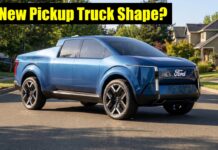
Ford is getting ever closer to showing us their all-new “Model T moment” midsize EV pickup truck. In the meantime, we are getting several more teaser images via a post by the Ford CEO, Jim Farley. Here’s everything we know so far. Let’s dig in.
This is a significant effort by Ford. The company is focused on pickup truck and truck-based SUV business in the United States. Ford is very good at designing pickup trucks, but the company is being challenged on many fronts. This is competition from their fellow legacy U.S.-based manufacturers, new companies such as Tesla, Rivian, TELO, and Slate. There is also a massive threat from the Chinese manufacturers.
Here is the first teaser image, followed by the caption from Jim Farley.

“The team is spending countless hours getting every last drop of aero efficiency on the mid-size electric pickup.”
Naturally, this makes a lot of sense as aerodynamic efficiency is critical to the driving range of any electric vehicle. The frontal area must be minimized and the overall shape must be just so. This is at odds with an overall shape of a pickup truck and the functional components, such as the side mirrors (pictured above). Most successful pickup truck designs usually have a squared off and upright front end with relatively large side mirrors for visibility.
Aerodynamics are even more important for this new affordable midsize EV pickup truck because Ford is targeting a starting price in the $30,000 range. Ford stated that the usable LPF (Lithium Iron Phosphate) battery capacity is 51 kWh. If you convert this amount of energy to gasoline, it’s an equivalent to about 1.51 gallons of gasoline.
Ford did not provide an estimated driving range figure, but this pickup truck will have to hit impressive efficiency between 4.0 – 4.9 miles per kWh in order to get between 204 – 250 miles of driving range from this 51 kWh battery. This would have to be same or better efficiency than the most efficient new Tesla, which is a Model 3 RWD sedan.
Another way to improve efficiency is to remove weight. We now have an industry expert confirmation that this upcoming EV pickup truck and electric vehicle architecture will use a 48-volt (not a 12-volt) base electrical system. This is a feature first introduced to the consumer market by the Tesla Cybertruck. Stepping up to 48 volts would allow Ford to decrease the amount of copper wire gauge inside the vehicle. It has other benefits with decreased overall weight being one of them.
Here is the second image.

“The best part is no part, but the second-best part is one that serves multiple functions.”
This caption and image are much more difficult to decode since we don’t know which part Jim is referring to. Naturally, low curb weight and simplicity is key to any great design. It appears that Ford’s team is looking at every optimization here.
The third image shows a little more of the front-end shape of the new pickup.
“A Ford team member working on the front end of a prototype – one of the hundreds of prototypes the team has designed and developed to shape the face of the truck over the last few years.“
We have to assume that the show prototype front end is one of the final or most recent ones. It’s solid front fascia with what appears to be an air inlet grille in the lower bumper area. It also shows an open hood lid, so this new pickup truck may have a frunk that is designed similar to a Rivian R1T.
Finally, here is this.

The caption is: “Ford will use large unicastings for the first time on the Universal EV Platform. The radically simplified aluminum unicastings condense over 146 parts into two and enable the assembly tree method at the Louisville Assembly Plant.“
Condensing parts and simplifying the manufacturing process is an important part to keeping the overall cost of this pickup truck low. Tesla popularized a “gigacasting” manufacturing process to produce large underbody structures. There are many benefits to building vehicles this way. It means this midsize pickup truck will effectively be a unibody vehicle. There is nothing wrong with this from a structural perspective. However, accident repair costs is a whole different story.
These pickup trucks and other vehicles that are based on the same platform will be built at the Louisville Assembly Plant that used to produce the Ford Escape. Ford Escape production stopped at the end of 2025. The facility is now being retooled.
The latest information we have says that Ford plans to start production of this midsize EV pickup truck by the end of this year. If the schedule is maintained, it means these should go on sale in the first half of 2027. This is not a statement by Ford. This rough schedule is based on an industry expert report.
Here is a close look at a 2025 Ford Maverick AWD hybrid that was one of our long-term test trucks.