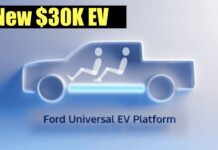
Ford’s engineers sweated the details as part of its new ‘Universal Electric Vehicle’ project that will create a new midsize truck in 2027.
Last year, Ford Motor company outlined what it called its ‘Model T moment’ — one of the most critical in its 122-year history. The Universal Electric Vehicle (UEV) platform, as its called, will launch a range of new, more affordable electric vehicles as the Blue Oval reconsiders its architecture and manufacturing processes for its next era of vehicles. On Tuesday, the automaker released a video outlining some of the technical aspects of those changes, although we still don’t have an actual production vehicle to graft these ideas onto just yet (we’ll see that in about a year’s time, if not a little sooner).

This engineering and design walkthrough outlines the fundamental aspects of Ford’s much-hyped $30,000 electric truck, including its approach to dramatically reduce the number of parts needed to build it in the first place. By reducing complexity, the company aims to make its next-generation vehicles cheaper to build — and hopefully, reducing bottom-line prices for consumers in the process.
If the idea of reducing the overall number of parts sounds familiar, that’s because it’s a concept newer EV makers have already brought to the space. Tesla’s gigacasting process is one example while Rivian has also made strides to reduce costs (in part, to boost profitability) by eliminating extraneous parts and optimizing efficiency throughout the whole vehicle/system rather than focusing on certain parts of a vehicle. This concept is finally making its way to more “legacy” EVs, though, as they make efforts to stay competitive in an incredibly fierce market.

Ford is also implementing what it calls unicastings into its new electric truck.
Compared to the Maverick, which has a body structure comprising 146 separate components, the new truck will have just two parts, with the battery pack (that pulls double-duty as a structural component) between them. The small pieces that are typically welded, fastened or glued together are going to be part of a few single, massive aluminum castings moving forward.
To improve its manufacturing processes as well as improving EVs’ aerodynamic efficiency, tying into battery size, weight and range, Ford brought over people and ideas from the Formula 1 world. Those folks flipped the conventional idea of using wind tunnel development at the start of the development process, for example, to optimize aerodynamic efficiency as designers put pen to paper, rather than using it at the end (when the design can’t really change much) to validate earlier design concepts and simulations.
“To the air, it is no longer a truck”, says advanced aerodynamics senior manager Saleem Merkt.
Under a “fail fast, learn faster” mentality, Ford also outlined using modular, 3D-printed parts for the test vehicle. That lets the team swap pieces in and out in just a few minutes, rather than having to build whole new models. Aerodynamic detail is a huge part of Ford’s “bounty targets”, or metrics the automaker is targeting to hit certain design, cost and performance aspirations as it quickly moves through the development cycle.
One of the subtler means Ford’s team tackled some of those metrics was the “1.5-mile mirror”. Conventional mirror housings these days house two separate electric motors to control the glass adjustment and the power-folding capability. With this new electric truck, there’s only one actuator — a change that allowed the team to also shrink the total mirror assembly by 20%. So, there’s less frontal mass and less weight, resulting in 1.5 miles of added range. “That doesn’t sound like a lot,” Merkt says, “but these marginal gains add up”.


As far as the battery pack itself, Ford landed on a lithium iron phosphate (LFP) battery chemistry, again to reduce costs.
These batteries cost about 20-30% less than nickel-manganese-cobalt-aluminum (NMCA) battery packs, though the modular approach of Ford’s UEV platform allows different chemistries and cell layouts depending on the application. Overall, chemistry makes up a huge delta in terms of cost competition between U.S. OEMs and Chinese automakers, some of which enjoy a 40% cost advantage. If there’s money to be saved (and battery packs comprise between 30-40% of the cost to build an EV), cell chemistry is a huge chunk of that potential.
Ford is also reducing as much as 4,000 feet of wiring and 22 pounds with the midsize electric truck’s wiring harness against the Ford Mustang Mach-E, using a “zonal architecture” with fewer processors on-board (five in total, all designed in-house by Ford instead of from third-party suppliers), and lighter 48-volt wiring handling the bulk of the electronics, stepping back down to 12 volts where needed for things like the lights and audio system.
The punchline? Ford has big EV plans, but we have to see what the final truck will be.


At the moment, we don’t have an idea beyond aerodynamic renderings exactly what the truck will look like. We also don’t have formal specs like its actual range, charging capability, power, payload, towing, or any of that good stuff. It remains to be seen just how close Ford will land to that purported $30,000 mark, either…so there are still plenty of question marks.
Nevertheless, it’s clear the UEV project is a massive undertaking. It’s one that has been years in the making, according to Ford’s team, even before it pivoted away from making other EVs like the F-150 Lightning. The current market for electric vehicles is cooling down a bit (market share actually dropped slightly in 2025), but if Ford can actually deliver a cost-conscious option that looks good with some meaningful capability, then perhaps a few more people will give it some serious consideration.